

SUSTAINABILITY Employee Relations
Promoting Diversity, Equity & Inclusion (DE&I)
Basic Concept
At Lawson, diversity, equity, and inclusion (hereinafter DE&I) are part of our business strategy.
Our goal is to be a company that promotes diversity among its employees, treats each individual fairly, embraces differences, and encourages everyone to voice their ideas and take on challenges.
D (Diversity)
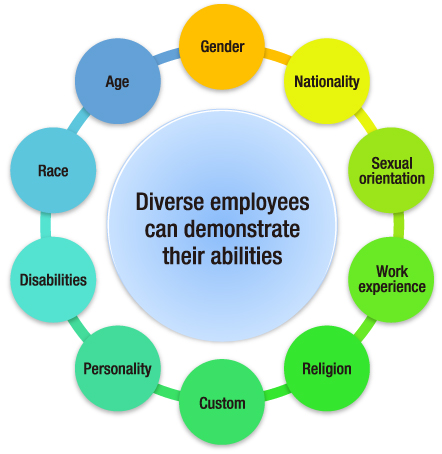
We welcome with smiles a diverse range of members, not only in terms of gender, race, and age, but also in regard to their individual personalities, customs, and religions.
E (Equity)
We provide the necessary resources according to each individual’s background and support each individual so that everyone can voice their ideas and take on challenges.
I (Inclusion)
We create an environment in which each individual respects others as fellow workers, recognizes their values, and all are united as one.
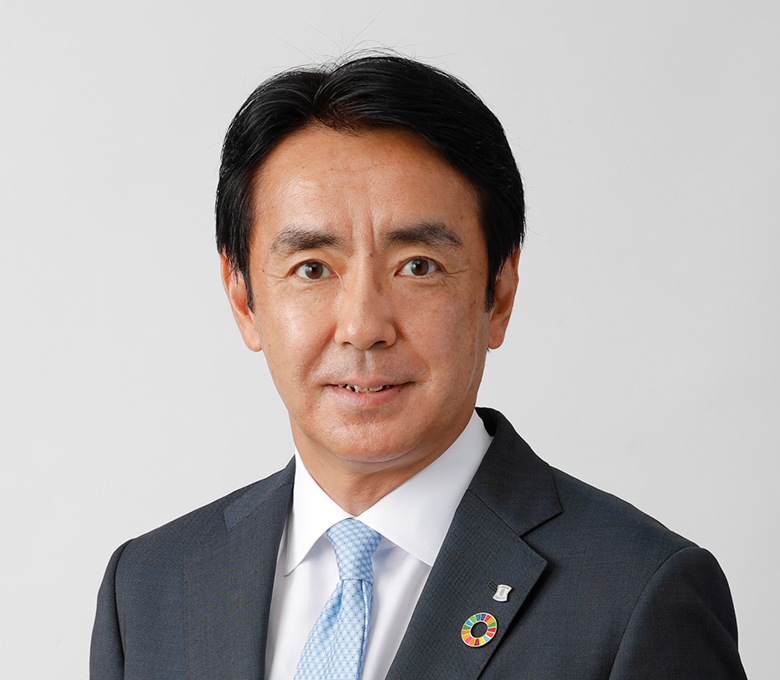
- Sadanobu Takemasu
President and CEO
Representative Director
Chairman of the Board
Diversity, Equity & Inclusion (DE&I) Policy
-
"Creating Happiness and Harmony in Our Community." This is Lawson's Group Philosophy. It means contributing to our communities and bringing happiness and harmony to both communities and ourselves by embracing the diversity around us and creating products and services that meet the needs of changing environments.
Differences in personal background, including race, religion, and type of employment, lead to varying perspectives among individuals and within society.
We also aim to grow as a member of the global community and engage with diverse individuals in Japan and around the world to enhance our corporate value.
We will contribute to the happiness of communities and society by developing an environment in which each of our diverse employees can fully demonstrate their abilities, regardless of gender, gender identity or expression, sexual orientation, disabilities, nationality, or age; leveraging each other’s strengths as an organization; and creating new value in the form of products and services.
DE&I is one of the essential strengths that drive Lawson’s growth and we will continue to actively promote and embrace DE&I. -
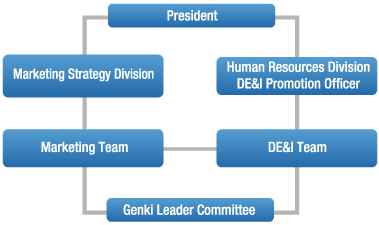
Framework for Promoting Diversity, Equity & Inclusion (DE&I)
-
An officer in charge of DE&I promotion reporting to the President and CEO cooperates with the Human Resources Division in promoting the design, operation and arrangement of necessary programs.
The Marketing Strategy Division draws on input from female employees, moreover, to conduct marketing aimed at creating new business value.Elected leaders representing Lawson’s business areas nationwide also attend regular meetings of the Genki Leader Committee, which is organized to promote DE&I, revitalize internal communications and promote employee health.
-
Declaration on Promotion of Female Employees' Career Development
Declaration of intent
As part of our diversity, equity, and inclusion (DE&I) promotion,
Lawson promotes the empowerment of women.
Diversity in human resources is essential for innovation.
Lawson will continue to proactively recruit a diverse range of employees, including women and non-Japanese people. As we believe that creating and fostering an environment in which women can play an active role will enhance the value of the company, we will continue to actively promote the empowerment of women.
Targets for Empowering Women
Lawson's qualitative target for empowering women is to create a workplace where female employees, including those who are mothers, can excel. Our quantitative targets are to have a 30% ratio of female employees by fiscal 2030, and to raise the ratio of managerial positions held by women to 30% by fiscal 2030.
Since 2005, we have been actively recruiting women with the goal of raising the ratio of female recruitment among new graduates to 50%.
Data on Female Employees
| Ratio of women among managers | FY2020 | FY2021 | FY2022 | FY2023 | FY2024 |
| Number of female managers (ratio of total female employees) |
121 11.40% |
134 12.20% |
154 13.77% |
159 14.13% |
167 14.92% |
|---|---|---|---|---|---|
| Number of female senior managers (ratio of total female employees) |
10 6.17% |
14 8.30% |
11 7.14% |
15 9.09% |
16 9.09% |
| Number of female (Deputy) Senior Vice Presidents* (ratio of total female employees) |
2 6.00% |
2 6.00% |
2 6.06% |
1 3.33% |
4 10.53% |
| Number of female corporate officers* (ratio of total corporate officers) | 6 46.15% |
6 50.00% |
5 50.00% |
5 50.00% |
3 27.3% |
* Officers refers to members of the board and corporate auditors. Also, executive officers refers to executive officers and director executive officers.
Key Initiatives to Empower Women
- Selective Leadership Training Program for Female Employees
In order to develop female executive candidates in the sales line, we conduct a “Selective Leadership Training Program for Female Employees” and provide regular opportunities for female directors and the President to have direct dialogues with female employees.

- Implementation of female employee career design training
We carry out a training program for female employees in their late twenties to early thirties who are highly likely to experience life events while working. In this program, we share information on our DE&I initiatives and how female employees are empowered, as well as carry out a panel discussion with senior employees who have continued working energetically even after their life events so that the participants can paint a vision of their own careers.

- Implementation of Training Programs for Employees on Childcare Leave
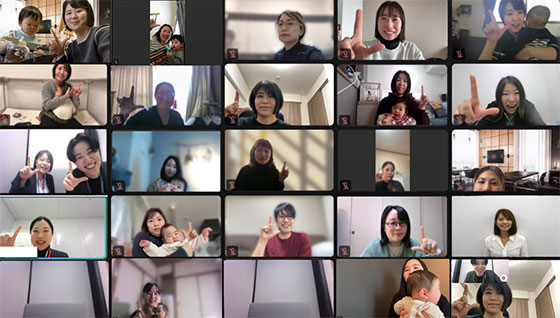
We carry out group training programs for employees on childcare leave with the purpose of providing the latest corporate information (e.g., business plan for new fiscal year, corporate systems, and employee benefits) and helping them to build their career after reinstatement and create networks. This dispels the participants’ anxiety about reinstatement and helps them to work proactively.
This training has been attended by many employees who are mothers, but in recent years, the participation of employees who are fathers has increased.
- Creation and Distribution of a Diversity Promotion Booklet “Lawson Work Style Handbook”
While sending the message from top management to employees toward the promotion of diversity, this handbook introduces career paths and systems to support employees working while raising children, as well as information on role model employees. By sharing information with all employees, we increase opportunities for them to obtain necessary basic knowledge and promote the creation of an environment in which employees can work comfortably while respecting each other.

Support System for Balancing Childcare and Work
| Childcare Leave System | Employees can take childcare leave until the child reaches four years of age. |
|---|---|
| Short-Term Childcare Leave System | Employees can take special paid leave for up to five days within the six months following the 57th day of birth. |
| Childcare Leave for Fathers at Birth | Employees can take leave for up to 28 days within the 56 days following birth. |
| Reduced working-hour system during childcare | Employees who have children in the third grade of elementary school or below may elect to reduce their working hours by up to three hours per day. ・Both the reduced workdays system and the holiday day-off system can be used concurrently. ・Can be used regardless of gender, job type, or official position. |
| Reduced working days | Employees who have children in the third grade of elementary school or below may elect to work only three or four days per week. ・Both the reduced working-hour system and the holiday day-off system can be used concurrently. ・Can be used regardless of gender, job type, or official position. |
| Special holiday on national holidays | Employees who have children in the third grade of elementary school or below may elect to take national holidays off. ・Both the reduced working-hour system and the reduced workdays system can be used concurrently. ・Can be used regardless of gender, job type, or official position. |
| Leave for nursing a child, etc. | Employees with children up to the third grade of elementary school can use this system for childcare, vaccinations, medical checkups, class closures, or participation in entrance/graduation ceremonies and other events. ・Up to 5 days per year can be used per child. |
| Restrictions on overtime, night work, and work outside regular hours | Employees with children below school age can restrict overtime (24 hours per month, 150 hours per year), night work, and prescribed outside work. |
| Staggered working hours system | A system where employees can choose their starting time. Options among 8:00–16:45 (Shift E), 9:00–17:45 (Shift F), or 10:00–18:45 (Shift G). |
| Transfer to accompany spouse | When the employer of an employee's spouse transfers said spouse, resulting in a change of residence, consideration is given to moving the employee's place of work to the same area. ・Can be used regardless of gender, job type, or official position. |
| Flexible Employee System | Employees can limit their workplace or working hours for reasons such as childcare, nursing care, medical treatment, fertility treatment, side jobs, or recurrent education. |
| Remote work | Employees engaged in work suitable for remote work are eligible to work remotely. |
| Various Daycare, Babysitting, and Support Services | It is possible to use services provided by Benefit Station. ・When using a service selected from babysitting services, a subsidy of 700 yen per hour (up to two hours a day and 30 hours a month) can be received with a limit of 21,000 yen per month. ・A system where a subsidy can be received when using a monthly childcare service at a daycare center or sick child daycare services. ・A subsidy can be received when using a childcare service at a family support center registered to the Japan Association for the Advancement of Working Women and listed on its website. |

- Lawson received the "Platinum Kurumin" Certification Mark
as a supportive company for employees with children

- Lawson received the "Kurumin" Next-Generation Certification Mark
as a company that works to improve its employees' work-life balance
- Happy Lawson Daycare Center
In fiscal 2006, we started to look after the children of our employees at an internal daycare center on national holidays. Our business operates even on national holidays, but regular nursery and elementary schools do not. As a result, working mothers expressed their concern at being unable to work on these days as they had nowhere to leave their children. In response, we established the in-house daycare center. In July 2014, we established the Happy Lawson Daycare Center on the first floor of Gate City Ohsaki's east tower, where Lawson's headquarters is located. We established the daycare center to address the persistent shortage of daycare in Tokyo and to enable employees seeking to quickly return to work from childcare leave for the sake of their careers to do so. Employees of the Lawson Group can use the center on a monthly basis or on national holidays.

Encouraging Male Employees to Take Childcare Leave
We introduced the "Short-Term Childcare Leave System" in fiscal 2014 to encourage male employees to take childcare leave.
We are also working to create a workplace environment where childcare leave can be taken more easily by putting up posters in workplaces and distributing confectioneries with the names of children to departments where employees taking childcare leave belong. The rate of male employees taking childcare leave surpassed 80% in fiscal 2016, and the rate has continued to exceed 90% since fiscal 2018.
As birth and childcare leave (childcare leave for fathers after birth) was introduced on October 1, 2022, e-learning was carried out for all employees and managerial staff members respectively in order to let them know about the system and promote employees to take the leave.
In recent years, the number of men taking long-term childcare leave has been increasing, and we believe that not only promoting leave-taking but also fostering understanding among those around them is necessary. For example, in the company newsletter, we introduced perspectives from both male employees taking one year of childcare leave and the supervisors supporting them, aiming to create an environment where the whole team can support balancing childcare and work.
As a result, regarding the use of the long-term and short-term childcare leave systems by male employees, the rate of childcare leave taken was 101.2% and the average number of days off taken was 24.3 in fiscal 2024.
▼A poster encouraging male employees to take childcare leave

▼Percentage of Male Employees Taking Childcare Leave

Return-to-Work Rate after Childcare Leave
In the accumulated total since fiscal 2020, the ratio of employees reinstated after childcare leave was 97.0%. The ratio of working mothers to all female employees has increased approximately seven fold since fiscal 2001.
▼Cumulative total spanning FY2020 to 2024

▼Ratio of working mothers to all female employees

Recruitment of Diverse Human Resources
Recruitment Policy
In hiring human resources, in accordance with the Lawson Group Human Rights Policy, we place importance on the aptitude, motivation, and ability of each individual, regardless of gender, gender identity or expression, sexual orientation, nationality, age, educational background, or origin.
Active Recruitment of Non-Japanese Employees
Since we started actively recruiting non-Japanese employees in 2008, we have been hiring new graduates with a target of 10 to 20% non-Japanese employees. At present, we have more than 140 non-Japanese employees, mainly from China and South Korea, who are actively working in various departments.
Promoting Hiring of People with Disabilities
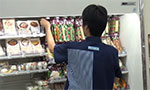
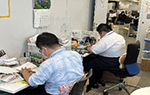
Lawson Will, Inc. was established to employ persons with disabilities (officially registered as a special subsidiary1 on January 31, 2013). Lawson Will has employees with disabilities who perform commissioned work for the Group. These employees currently work in offices, perform light duties in warehouses and stores, and take part in other operations.
The Group hiring ratio of persons with disabilities2 stands at 2.39% (as of the end of February 2025).
Offering a work environment and opportunities to persons with disabilities who have the will and capability to work is part of Lawson's corporate mission. We will continue to implement measures to promote diversity within our organization.
- Notes :
-
- 1.
- Special subsidiary: A company with certification from the national government in special consideration of the hiring of people with disabilities.
Laborers employed at a special subsidiary may be regarded as hired by the parent company and included in calculation of the parent's (or group's) hiring ratio of persons with disabilities. - 2.
- The Group hiring ratio of persons with disabilities is calculated based on the total number of employees of Lawson, Inc., Lawson Will, Inc., Lawson Entertainment, Inc., and Lawson Store 100, Inc.
Lawson Will, Inc.
| Capital | 10 million yen |
|---|---|
| Location | 11-2, Osaki 1-chome, Shinagawa-ku, Tokyo 141-8643, Japan |
| Established | August 1, 2012 |
| Employees | 42 (including 41 persons with disabilities) |
| Business activities | Accepts work from other Group companies on commission |
Assistance for People with Disabilities to Work Proactively
We are working hard to create an environment where employees can better understand people with disabilities by implementing initiatives such as mandatory e-learning training programs for all employees and optional study sessions. In actual workplaces, we are currently testing an initiative where store employees with disabilities wear a bib indicating the work they are in charge of so that they can work with ease of mind.
We have also been rolling out, on an irregular basis since 2022, MACHI café cups, Kara-age Kun packages, and tissue boxes featuring designs created by artists with disabilities at stores nationwide for a limited time.
In FY 2024, tissue boxes designed by designers attending the welfare facility “Ponpon,” operated by certified NPO “Hull Pong” in Asaminami Ward, Hiroshima City, were rolled out (currently ended).
We also used designs by the artist for the cover of the SDGs Handbook, which shares the Lawson Group’s SDG initiatives both internally and externally from 2022 to 2024.
In November 2022, art toilets were rolled out at three stores in Tokyo and Kanagawa (the designs at that time have since ended). In addition, from May 2023, art toilets with designs themed on Hokkaido forests and flowers by artists from social welfare corporations have been rolled out at two stores in Sapporo City, Hokkaido (currently ongoing).
At stores in Saga Prefecture, real art toilets, in which artists from welfare facilities apply designs directly inside the restrooms, have been rolled out (since November 2023).
We will continue working to create an environment where persons with disabilities can play an active role.
Works Drawn by an Artist from a Welfare Facility

▲ Tissue Box (sales ended): Welfare Facility Ponpon (Hiroshima Prefecture)

▲ Art Toilet: Welfare Facility PICFA (Kiyama Town, Saga Prefecture)
Creating an Environment in which Diverse Human Resources Can Work in Comfort
Conducting Employee Awareness Surveys and Improvement Activities
Once a year, we conduct an employee awareness survey on all employees to visualize corporate issues and improve organization management. We compare answers for questions in the categories of the company, work, workplace, superiors, systems, as well as autonomous career development year on year and analyze changes from the previous survey, factors, and correlation between answers.
Results of the employee awareness survey in fiscal 2024 were the best in the past five years.
Overall satisfaction index result: I am generally satisfied with working for this company
| FY2020 | FY2021 | FY2022 | FY2023 | FY2024 | |
|---|---|---|---|---|---|
| Affirmative Response Rate | 74.7% | 74.0% | 74.5% | 75.0% | 77.4% |
The results of the employee awareness survey are reported in Executive Committee Meetings and utilized to examine measures and systems for solving corporate issues. In addition, based on the survey results, we create a chart for each organization and share the overview of the survey results and chart for the relevant organization with all employees to provide feedback. In each organization, the organization manager shares improvement activities to solve issues in the relevant organization with members and carries out dialogues with them so that everyone can participate in activities to improve their workplace.
In addition to the annual employee awareness survey, we introduced a simplified pulse survey at all branches nationwide starting fiscal 2023.
Because the results can be checked in real time, the survey enables us to promote the cycle of organization improvement activities while more rapidly grasping the present status and taking actions. We will continue to grasp employee engagement on the frontline at an early stage and implement improvement measures.
Job Satisfaction Reform Project
We have launched the Job Satisfaction Reform Project with the aim of creating a company where employees can continue to work with satisfaction. The members are recruited from within the company, and the activities are based on employee participation.
In FY 2024, under the two themes of “enhancing job satisfaction” and “improving productivity,” we considered and implemented initiatives such as improving existing systems and frameworks, creating opportunities for voluntary learning, and measures to activate communication, enabling employees to feel vibrant growth as they work.
Holding of Lawson Lively Link, a cross-departmental online seminar
Lawson Lively Link, a cross-departmental online seminar for all employees, is held twice a month with the aim of stimulating internal communication and employee career development. In addition to the department profiles, we continuously plan and promote various programs, including consolidated subsidiaries and affiliates, which deepen connections among consolidated subsidiaries and affiliates, Close-up ○○, which introduces initiatives in each area or division such as teams formed by international employees, and Projects Receiving President’s Awards, which highlight employees’ challenges and the background behind them.
We are working to deepen employees’ understanding of the company and to promote vertical, horizontal, and diagonal communication.

Creating an Environment to Induce Challenges: 100 Million Yen Challenge
We have conducted the 100-Million-Yen Challenge program since fiscal 2021 as part of the promotion of job satisfaction reforms project in which anyone can submit their ideas within a budget of 100 million yen spared for a new challenge.
In fiscal 2024, 182 applications were received, of which 8 applying groups gave presentations to the president and officers. We have sorted out the cost and feasibility of each selected project and are working to materialize the ideas.
In 2024, the Kids Pastry Chef Experience, which was approved in 2023, has been materialized and implemented as an in-house project.
Through these measures, we will continue to promote voluntary challenges that go beyond routine work and existing frameworks, working to ensure that each employee can feel personal growth.

▲ Kids Pastry Chef Experience

▲ FY 2024 100 Million Yen Challenge Final Review Meeting
LGBTQ-Related Measures
We have been raising LGBTQ awareness through the e-learning course Human Rights and Diversity, which is held once a year. Starting in fiscal 2023, we have also adapted internal systems in stages by expanding the scope of personnel systems and benefits.
We have started to provide wedding gift money and apply the company housing system to marriages with same-sex partners.
We have also enabled employees to use in-house common names regarding gender identity upon request.
We also operate an LGBTQ consultation desk for anonymous consultation and service, which is available not only for headquarters employees but also for franchise store owners and store crews.
These initiatives were highly evaluated, and Lawson received the Gold rating in Pride Index 2024 for the second consecutive year, an index that evaluates LGBTQ+ initiatives in the workplace.
During the Pride Month of June 2024, we promoted a rainbow package for Kara-age Kun, aiming to establish an inclusive hub of refreshment in every community where it is easy for diverse people to work and live.
We will continue working for information provision and environmental improvement with the aim of creating a working environment friendly to everyone by promoting the understanding of LGBTQ and fostering an "Ally" culture.
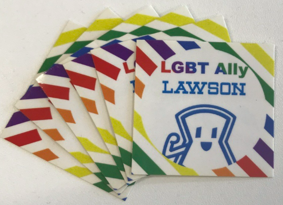
▲ Handing out stickers to support LGBTQ to persons who wish them

▲ LGBTQ Kara-age Kun (Rainbow Color)
Appreciation from Outside


Lawson was selected as a “Nadeshiko Brand” for five consecutive years in 2014, 2015, 2016, 2017 and 2018 in recognition of its achievements as a listed company in promoting female employees’ career development. After three years, we were selected for our 6th time in 2021. Selection for the award is made jointly by the Ministry of Economy, Trade and Industry and the Tokyo Stock Exchange.
In 2015, moreover, Lawson was honored with Diversity Management Selection 100 by the Ministry of Economy, Trade and Industry in recognition of the Company’s achievements in generating innovation by utilizing the diverse talents of women, foreign nationals, and elderly and physically challenged people.
Lawson was honored with the Special Award in the 2015 Ikumen Company Award competition by the Ministry of Health, Labor and Welfare.
As a company that considers society and an environment where everyone can participate fairly, and that continuously takes required actions, we registered our company as a “Tokyo Barrier-free Mindsets Support Corporation.” Furthermore, we were selected as a good example of a “Tokyo Barrier-free Mindsets Support Corporation” in fiscal 2022 as we were certified for carrying out especially excellent initiatives in terms of the spirit of innovation, uniqueness, and ripple effect.
Our initiatives, including the establishment of a same-sex partner system and an LGBTQ consultation desk, as well as seminars for promoting the understanding of LGBTQ, were highly evaluated, and Lawson received the Gold rating in Pride Index 2024 for the second consecutive year, an index that evaluates LGBTQ+ initiatives in the workplace.
Personnel Data
| FY2020 | FY2021 | FY2022 | FY2023 | FY2024 | |
|---|---|---|---|---|---|
| Number of employees (non-consolidated) (Numbers)*1 | 4,790 | 4,652 | 4,490 | 4,395 | 4,386 |
| (Men/Women) (Numbers) | 3,847/943 | 3,724/928 | 3,577/913 | 3,495/900 | 3,445/941 |
| Ratio of female employees (%) | 19.7 | 19.9 | 20.3 | 20.5 | 21.5 |
| New graduates hired (Numbers) | 221 | 118 | 89 | 98 | 107 |
| (Men/Women) (Numbers) | 122/99 | 60/58 | 43/46 | 65/33 | 63/44 |
| Mid-career employees hired (Numbers) | 35 | 22 | 37 | 75 | 99 |
| (Men/Women) (Numbers) | 18/17 | 14/8 | 20/17 | 48/27 | 63/36 |
| Ratio of women among managers (%) | 10.7 | 11.7 | 13.0 | 13.5 | 14.2 |
| Number of employees who took maternity leave (Numbers) | 20 | 27 | 57 | 48 | 50 |
| Number of employees who took childcare leave (Numbers) | 162 | 127 | 161 | 192 | 183 |
| (Men/Women) (Numbers) | 117/45 | 89/38 | 104/57 | 100/92 | 84/99 |
| Number of employees who used the reduced working hours for childcare system (Numbers) | 73 | 97 | 102 | 118 | 113 |
| Home teleworkers (Numbers)*2 | 1,547 | 3,167 | 3,181 | 2,921 | 3,012 |
| Number of employees who took nursing care leave (Numbers) | 1 | 1 | 2 | 1 | 1 |
| Average monthly overtime hours | 9.40 | 10.48 | 10.90 | 11.28 | 11.20 |
| Utilization rate of paid vacation (%) | 54.2 | 57.2 | 60.42 | 59.13 | 61.86 |
| Average age (years) | 40.2 | 40.9 | 41.7 | 42.3 | 43.0 |
| (Men/Women) (year) | - | - | 43.4/34.9 | 44.0/35.8 | 44.7/36.3 |
| Average years of service (year) | 13.6 | 14.3 | 15.2 | 15.9 | 15.5 |
| (Men/Women) (year) | 15.0/8.1 | 15.7/8.9 | 16.6/9.7 | 17.3/10.4 | 17.0/9.9 |
| Turnover rate (%) | 6.3 | 6.9 | 7.0 | 7.0 | 6.3 |
| Number of employees leaving the company (persons) | 301 | 321 | 315 | 306 | 276 |
| Percentage of employees with disabilities (%)*3 | 2.25 | 2.29 | 2.29 | 2.23 | 2.39 |
| Starting salary (yen)*4 | University: 211,000 yen (monthly salary) Graduate school: 224,620 yen (monthly salary) |
University: 211,000 yen (monthly salary) Graduate school: 224,620 yen (monthly salary) |
University: 211,000 yen (monthly salary) Graduate school: 224,620 yen (monthly salary) |
University: 217,000 yen (monthly salary) Graduate school: 230,620 yen (monthly salary) |
University: 233,000 yen (monthly salary) Graduate school: 240,600 yen (monthly salary) |
| Gender wage gap (All workers) (%)*5 | - | - | 62.5 | 62.4 | 64.1 |
| Subset of regular employees (%) | - | - | 80.8 | 81.8 | 83.9 |
| Subset of non-regular employees (%) | - | - | 88.1 | 91.9 | 92.0 |
- Notes :
-
- 1.
- The number of employees (non-consolidated) is the total number of employees - (seconded to affiliates, accepted seconded to affiliates)
- 2.
- Remote work system for all employees was introduced in September 2020. The number of employees is the number of people who applied to use the system in September 2024.
- 3.
- The employment rate of people with disabilities is based on the Group total (Lawson, Inc., Lawsonwill, Inc., Lawson Entertainment, Inc. and Lawson Store 100, Inc.) and employment contracts.
- 4.
- For those living in the 23 wards of Tokyo. Other amounts may vary depending on work location, residence, etc. The same wage system is applied regardless of gender.
- 5.
- Explanation on wage variance between men and women.
*Explanation on data calculation
- Subject period: Fiscal 2024 (from March 1, 2024 to February 28, 2025)
- Regular worker: Regular employees except for directors
- Non-regular worker: Contracted employees as well as part-time and temporary workers
For part-time and temporary workers, the average annual wage is calculated based on the number of workers assuming statutory working hours (8 hours/day).
*Supplemental explanation regarding differences
- Regarding regular workers, the shorter years of service of women (difference between men and women: 7.1 years), combined with a lower percentage of women in managerial positions (14.1%), create wage disparities.
In particular, among managerial positions, the percentage of women in senior roles (the percentage of female general managers being 9.1%) is low, which has a significant impact on wage disparities.
For this reason, we regard the empowerment of female employees as an important management requirement and are implementing human resource development measures, including career training programs for employees, aiming to achieve at least 30% ratios of female employees and women in managerial positions by 2030. - Regarding non-regular workers, the wage gap between men and women has resulted from the many male contract employees rehired after retirement who are receiving high wages compared to the many part-time female workers.
- The wage gap between male and female workers overall results from the high share of men (80%) as regular workers who receive relatively high wages, compared to the high share of women (64%) as non-regular workers receiving low wages.

- Message from the President
- Corporate Conduct Charter, Code of Ethics, and Policies
- Identification of Lawson’s Material Issues
- Environmental Vision Lawson Blue Challenge 2050 !
- Participation in Initiatives
- Sustainability Promotion System
- TCFD Proposal Initiatives
- TNFD Proposal Initiatives
- Environmental Preservation and Corporate Citizenship Activities
- Carbon-free Initiatives
- Initiatives for Global Environmental Conservation
- Supply Chain
- The Lawson Group's "Happiness in Communities" Fundraising
- Respect for Human Rights
- Customer Relations
- Owners
- Relationship with Suppliers
- Supplier Hotline
- Employee Relations
- Community Relations
- Supporting Safety and Security in the Community
- Corporate Governance
- ESG Data
- Special Feature
- Sustainability Report


